
Why Asset Data Is Rarely Trusted
Why do so many leaders hesitate to trust their asset data? This article explains the operational realities behind the issue and what it takes to make data credible enough to drive real decisions.
Casey Lehman
12/12/20252 min read

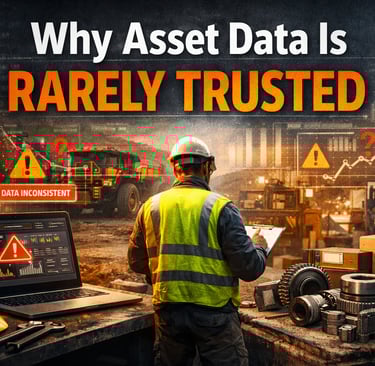
Why Asset Data Is Rarely Trusted
I’ve yet to meet a maintenance or reliability leader who says they fully trust their asset data.
Most mining and manufacturing organizations have no shortage of systems—CMMS, ERP, historians, dashboards. Reports get published, KPIs get reviewed. But when it’s time to make a real decision, the conversation usually pauses and someone says it plainly: I’m not sure I trust the data.
That hesitation is more common than anyone likes to admit.
Data Is Built Under Pressure
Asset data is created where the work happens. Work orders are closed during shift change. Failure codes are selected quickly. Meter readings are entered late or estimated when production is tight. None of this is intentional—it’s operational reality. Over time, data becomes something required to move on, not something trusted to drive decisions.
The result is a system that records activity well, but doesn’t always explain performance.
Asset Structures Drift
Most asset hierarchies start clean. Then equipment is modified, components change, and naming conventions drift by site. Similar assets end up structured differently across the same organization. When leaders can’t confidently compare performance across assets or sites, reports stop carrying weight and experience fills the gap.
Once that happens, trust is hard to recover.
Manual Data Doesn’t Scale
Mining and manufacturing generate massive volumes of data, yet much of it still relies on manual entry. Manual processes introduce delay, inconsistency, and interpretation. At scale, that gap widens quickly. The issue isn’t effort—it’s that manual data capture can’t keep up with the pace of operations.
As variability increases, confidence drops.
Ops and Maintenance See Different Truths
Operations experience the problem. Maintenance documents the fix. Without strong feedback loops—especially through planners and reliability roles—those perspectives never fully connect. When operations don’t see their reality reflected in reports, engagement drops. When engagement drops, data quality follows.
The gap shows up clearly in the numbers.
Spare Parts Are Treated Separately
Spare-parts data is often managed as a supply-chain issue instead of an asset-performance one. That’s how organizations end up with excess inventory in low-risk areas and shortages where failures matter most. When parts strategy isn’t tied directly to asset risk and maintenance execution, inventory data becomes just as hard to trust.
Disconnected strategies produce disconnected data.
Why More Dashboards Don’t Help
When trust fades, the instinct is to add reporting—more KPIs, more dashboards, more meetings. But visibility doesn’t create credibility. Execution does. Data becomes trusted when it consistently drives the right actions and those actions lead to measurable improvement.
Without that loop, reporting only amplifies noise.
What Trusted Data Looks Like
In organizations that trust their data, a few things are usually true. Data standards are clear and decision-focused. Automation replaces manual entry where possible. Planning and reliability roles actively steward data quality. Regular operating cadences exist where data drives actions and follow-up. Spare-parts strategy is aligned to asset risk.
Most importantly, leaders use the data as an operating tool, not a scorecard.
The Real Shift
The shift that matters most isn’t technical—it’s operational. Asset data improves when it’s managed like a program, not just a system. Ownership is clear. Expectations are consistent. Leaders review data regularly and act on it the same way every time.
That’s how trust is built.
Final Thought
Most mining and manufacturing organizations don’t have a data problem. They have a trust problem. And trust isn’t fixed with new tools. It’s fixed by aligning how data is captured, how it’s used, and how leaders hold the organization accountable to it.
That’s where real reliability improvement starts.